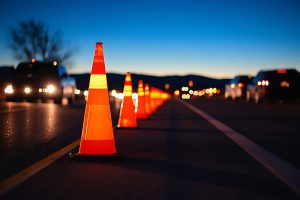
DWI roadblocks—also known as sobriety checkpoints—have become a prominent enforcement tool across New York State, reflecting the state’s ongoing commitment to reducing impaired driving. Their legal foundation is well established. At the federal level, the U.S. Supreme Court upheld the constitutionality of sobriety checkpoints in Michigan Dept. of State Police v. Sitz (1990), concluding that the state’s interest in preventing drunk driving outweighs the minimal intrusion on motorists. New York’s own courts reached a similar conclusion earlier in People v. Scott (1984), affirming that checkpoints are permissible under the state constitution when conducted according to strict guidelines.
The purpose of these checkpoints is straightforward: to deter and detect impaired drivers before they cause harm. Law enforcement agencies across the state deploy them during high‑risk periods—holiday weekends, late‑night hours, and near nightlife districts—where impaired driving incidents historically spike. Their presence alone is intended to discourage drivers from taking the wheel after drinking, and the state views them as a proactive measure rather than a reactive one. New York’s Vehicle and Traffic Law explicitly authorizes their use, reinforcing the idea that they are a legitimate and necessary tool for public safety.
Despite their legality, DWI roadblocks remain controversial. Some drivers argue that they feel invasive or unfair, raising concerns about privacy and constitutional rights. New York courts have addressed these concerns by imposing strict operational requirements. Officers must follow predetermined, neutral criteria—such as stopping every third or fifth vehicle—to prevent discriminatory or arbitrary enforcement. Checkpoints must be clearly marked, well lit, and supervised by higher‑ranking officers who ensure compliance with written guidelines. These safeguards are designed to minimize the subjective discretion of individual officers and protect motorists from unreasonable searches or seizures.
A DWI arrest in New York can have an immediate impact on your ability to drive. For many people, losing driving privileges means difficulty getting to work, attending school, obtaining medical treatment, or caring for family members. Fortunately, New York law provides a limited form of relief known as a hardship license, often referred to as a hardship privilege.
Understanding what a hardship license is, who qualifies, and how it differs from a conditional license is critical for anyone facing a DWI-related suspension.
What Is a Hardship License in New York?
A hardship license, formally known as a hardship privilege, is a court-authorized driving privilege that may allow a person whose license has been suspended following a DWI arrest to continue driving for limited essential purposes. It is not a full driver’s license and does not restore unrestricted driving privileges. Instead, it allows eligible motorists to drive only for specific, necessary activities approved by the court.
The hardship privilege is most commonly sought shortly after a DWI arrest when a driver’s license has been suspended pending prosecution. During this period, a driver may petition the court for permission to drive despite the suspension.
What Is the Purpose of a Hardship License?
The purpose of a hardship license is to prevent severe disruption to a person’s daily life while a DWI case is pending. New York courts recognize that some individuals rely heavily on driving for employment, education, medical treatment, and family obligations.
A hardship privilege may permit driving for purposes such as:
- Traveling to and from work;
- Driving during work hours when required by employment;
- Attending an accredited college, university, or vocational program;
- Obtaining necessary medical treatment for the driver or an immediate family member; and
- Other essential activities approved by the court.
Because the privilege is limited, any driving outside the approved purposes can result in additional penalties.
Who Is Eligible for a Hardship License?
Not everyone whose license is suspended after a DWI arrest qualifies for a hardship privilege. To obtain one, a driver generally must demonstrate that the suspension creates an “extreme hardship.”
An extreme hardship means more than mere inconvenience. The court will evaluate whether the driver has reasonable alternatives to driving. If public transportation, rides from family members, ride-sharing services, or other transportation options are reasonably available, a judge may deny the application. Conversely, if the inability to drive would jeopardize employment, educational opportunities, or necessary medical care, the court may find that an extreme hardship exists.
It is also important to note that drivers who refuse to submit to a chemical test, such as a breath, blood, or urine test, are generally not eligible for a hardship privilege in New York. A chemical test refusal can trigger separate administrative penalties and may prevent a driver from obtaining hardship driving privileges.
Common factors courts consider include:
- The driver’s work schedule and employment requirements;
- Availability of public transportation;
- Distance between home and work or school;
- Medical needs of the driver or family members; and
- Whether alternative transportation is practical and available.
Supporting documentation such as employer letters, school records, medical documentation, and transportation schedules may help establish eligibility.
When Should a Driver Apply?
Timing is critical. A hardship privilege is generally requested shortly after the driver’s license is suspended following arraignment. The request is made to the court handling the DWI case, and the judge will determine whether the driver has established the necessary hardship.
Because procedural requirements vary by court and individual circumstances, drivers often benefit from seeking legal advice as soon as possible after their arraignment.
Hardship License vs. Conditional License
Many people confuse hardship licenses with conditional licenses, but they are different.
A hardship license is granted by a court and is generally available during the early stages of a DWI case when a license has been suspended pending prosecution. A conditional license, on the other hand, is issued by the New York Department of Motor Vehicles and is typically available to eligible drivers who enroll in the state’s Impaired Driver Program (IDP).
A conditional license also allows limited driving privileges for approved purposes such as employment, education, medical appointments, court obligations, and participation in the IDP. However, eligibility rules differ, and not every driver qualifies. Commercial driver’s license holders are generally not eligible to use a conditional license for commercial driving privileges.
Final Thoughts
A DWI-related license suspension can create serious challenges, but New York’s hardship privilege may provide a temporary solution for drivers facing genuine transportation difficulties. To obtain a hardship license, a driver must demonstrate that the suspension creates an extreme hardship and that no reasonable alternative means of transportation exist.
Because these applications are highly fact-specific and subject to judicial discretion, preparing strong supporting documentation is essential. Anyone facing a DWI suspension should carefully evaluate whether they may qualify for a hardship privilege and seek guidance regarding the best strategy for preserving limited driving privileges while their case is pending.